
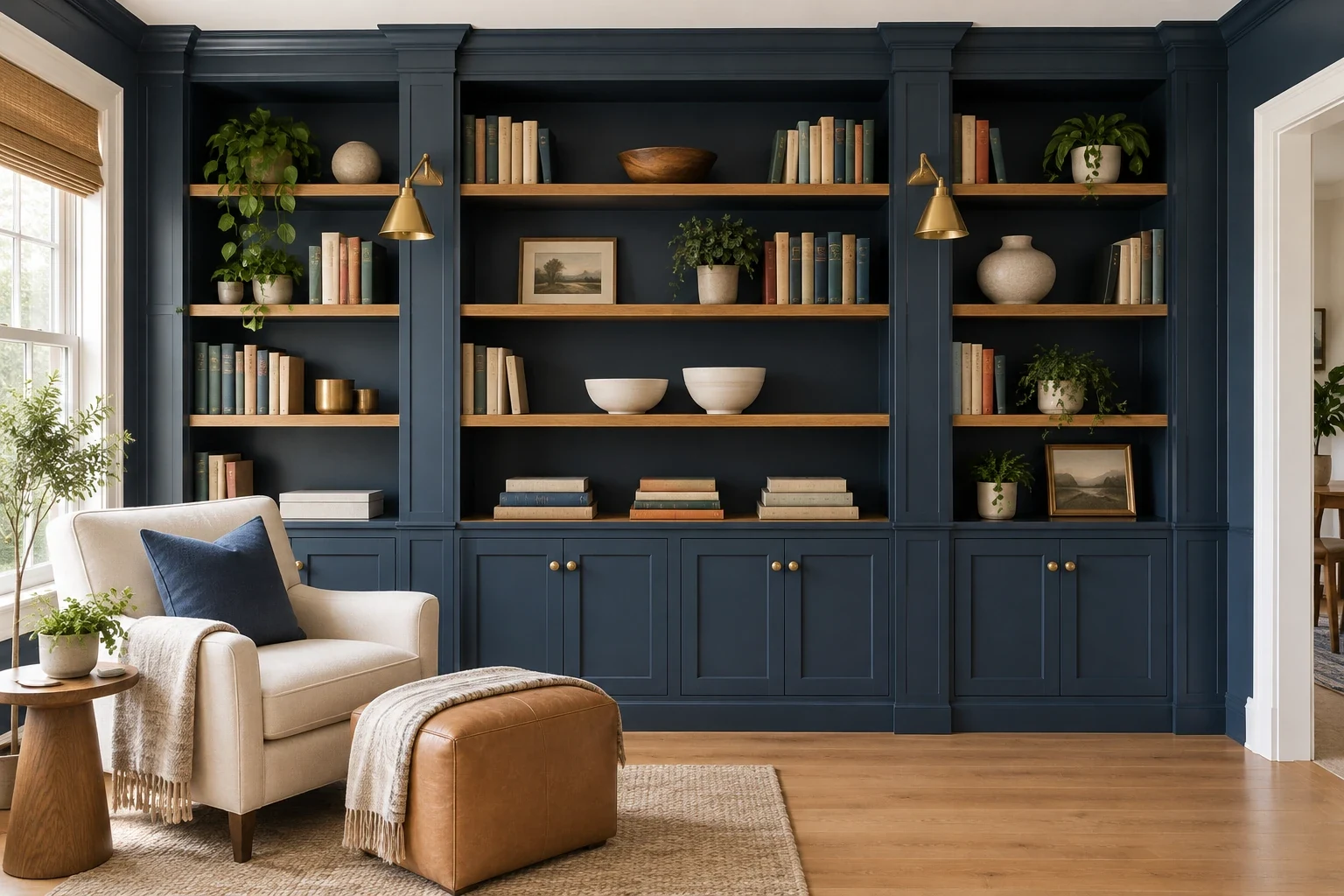
Leaving a foot of empty drywall above standard bookcases gathers dust and chops the room in half. Taking your shelving all the way up to the ceiling creates a seamless reading nook that feels built with the house. Painting the backboards and trim in a single saturated shade unifies the entire wall.
Reach the Ceiling

Run your shelving boards all the way up to the existing crown molding. This approach removes the awkward dust-catching gap at the top of standard bookcases and gives the unit a permanent, custom appearance. Measure the distance from your floor to the ceiling joists to calculate how many shelf tiers you need. Space the upper shelves about ten to twelve inches apart, which leaves just enough clearance for standard paperback novels and keeps the vertical lines looking proportional.
Add Brass Sconces

Mount brass swing-arm sconces directly onto the vertical wood stiles of your shelving unit. Hardwired lighting provides focused illumination for reading at night while breaking up the flat plane of the dark painted wood. Position the electrical boxes about five and a half feet from the floor so the bulbs sit right at eye level when you stand. If you want to skip the electrician, use battery-operated puck lights inside the sconce shades and attach the fixtures with heavy-duty wood screws.
Place White Bowls

Group a pair of soft white ceramic bowls on a middle shelf to break up the dense rows of spines. The pale ceramic finish pops against a dark navy backboard, drawing the eye to the center of your display. Pick bowls that measure six to eight inches across and nest them slightly off-center on the oak wood. You can use these open vessels to hold spare reading glasses or leave them completely empty to highlight their smooth, curved shapes.
Stack Books Flat

Lay a few colorful hardcovers horizontally to create sturdy platforms along your shelves. Mixing vertical rows with flat stacks adds visual rhythm to a large unit and gives you natural pedestals for smaller decorative objects. Stack three to four books together, placing the largest trim size at the bottom for stability. Keep the total height of the stack under eight inches so you still have room to slide your hand above the top cover when you need to pull one out.
Add Lower Cabinets

Install closed base cabinets along the floor to ground your shelving unit. Solid doors hide messy electronics, board games, and woven baskets for storage, keeping the open shelves above looking neat. Build these lower boxes twenty to twenty-four inches deep, which is standard for base cabinetry and provides a wide ledge for the upper bookcase to sit on. Finish the doors with simple brass knobs that match your wall sconces to tie the upper and lower sections together.
Prop Up Canvas Art

Lean a small framed landscape canvas against the backboard of an upper shelf instead of hanging it on a wall. This casual placement covers up empty painted space behind shorter paperbacks and brings different textures into the wood unit. Choose a canvas that is roughly eight by ten inches so it fits comfortably under the shelf above. Position it slightly behind a short stack of novels to create depth, making the shelf look layered rather than rigidly organized.
Pull Up a Leather Seat

Bring a tan leather lounge chair into the corner right next to your lower cabinets. Having comfortable leather seating in the room gives you a dedicated spot to sit and read the books you just pulled off the shelf. Pick a chair with a seat height of around sixteen inches so your feet rest flat on the floor. The warm tan leather introduces a durable, natural material that contrasts nicely with the dark blue paint of the surrounding woodwork.
Roll Out a Cowhide Rug

Place a brown and white speckled cowhide rug directly in front of the baseboards. An irregularly shaped area rug softens the rigid straight lines of the cabinetry and protects your oak flooring from chair legs. Look for a hide that measures at least five by seven feet to anchor the seating zone properly. The organic speckles and curved edges draw attention to the floor, balancing the heavy visual weight of the floor-to-ceiling shelves above.
Add a Potted Fern

Set a lush green maidenhair fern in a brass planter on the edge of a middle shelf. The delicate, trailing leaves spill over the rigid oak boards, bringing organic movement and bright color to the static book display. Buy a pot that is six inches in diameter so it fits securely on a standard twelve-inch deep shelf without hanging off the front. Water the fern once a week in the sink, letting it drain completely before putting it back on the wood.
Install a Rolling Ladder

Attach a brass sliding rail across high navy blue bookshelves to support a warm oak library ladder. Utilizing vertical wall space opens up several extra rows of book storage near the ceiling while maintaining safe physical access. Secure the brass track directly into heavy vertical wood stiles or structural wall studs at a height of seven feet off the floor. Thread the rolling hardware onto the rail and adjust the lower wheel assemblies so the ladder glides smoothly. This functional setup eliminates flimsy step stools and grounds the tall cabinetry with rich warm tones.
Hang a Ceiling Fixture

Swap out your standard room lighting for a brushed brass flush-mount ceiling fixture above the reading zone. A dedicated overhead light washes the entire face of the bookshelves, highlighting the dark paint color and the titles on the top rows. Select a fixture that drops down no more than eight inches from the soft white ceiling to keep the sightlines clear. Wire it to a dimmer switch on the wall so you can lower the brightness during quiet evening reading sessions.
Leave Breathing Room

Leaving empty space on a wide oak shelf highlights a single object, like the ceramic vase in the photo. Negative space prevents a massive wall of books from feeling cluttered and gives your eyes a place to rest. Clear at least eighteen inches of shelf space and center one simple piece against the navy backboard. This minimalist approach costs nothing and turns a basic storage shelf into a deliberate display area that feels calm and intentional.
Measure the depth of your largest art books before securing your shelf boards. The wood needs to be deep enough to support the entire cover without the spine hanging over the edge.
